Ricco’s Homepage
Biography
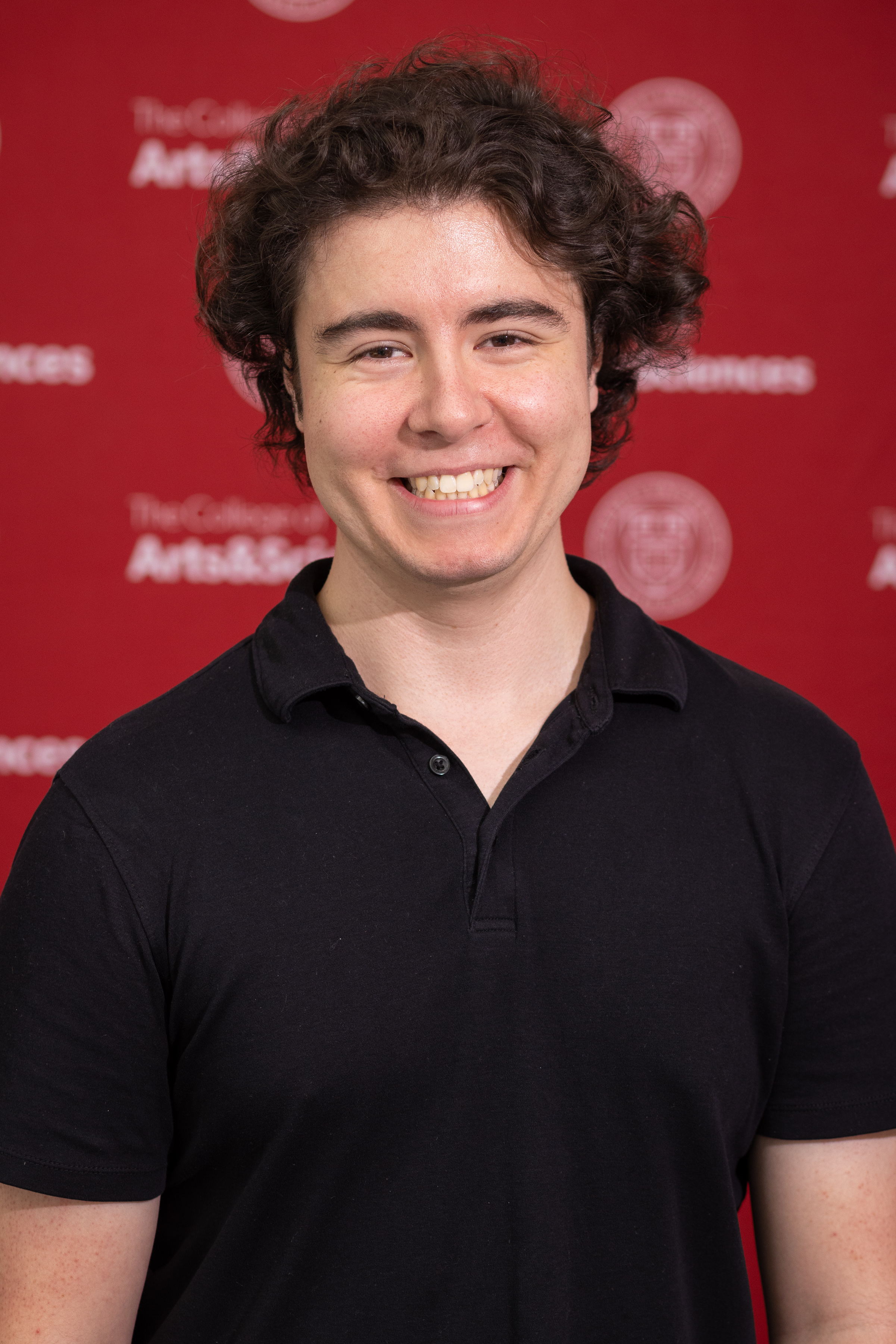
Hello! I’m very passionate about astrophysics research and pursuing ideas across disciplines, as well as increasing diversity in astronomy. In my free time, I like to play piano, bass guitar and chess. I’m also an avid reader, enjoying genres from classic literature to science fiction.
My academic genealogy includes Millikan, Rabi, Sommerfeld, Wilkinson, Oppenheimer, Zwicky, J.J. Thomson, Born, Ehrenfest, Pauli, and Weyl. My Einstein number is 5 (Battaglia → Bond → Fowler → Zwicky → Einstein). Through a summer program, my genealogy would also include Feynman under Professor Jim Gates.
I also played cello for 10 years, and my pedagogical genealogy includes Wang → Starker → Schiffer → Popper.
Research Background
I graduated from Cornell University with a major in astronomy with a concentration in astrophysics and a minor in physics. I have been conducting research at Cornell for over five years alongside Professor Nicholas Battaglia and Dr. John Orlowski-Scherer. After graduating, I was awarded a Fulbright Research Award to study cosmic rays at the University of Perugia under Professor Nicolas Tomassetti. I am currently attending the University of California, Riverside to pursue a PhD in Astronomy under Professor Steve Choi and am part of the Center for Experimental Cosmology and Instrumentation.
Current Research Interests
Through Professor Steve Choi, I have been calculating angular power spectra on the cosmic microwave background. This is extremely important to help us better understand the formation of the early universe and what processes led to its development and structure we see today.
Under Professor Battaglia and Dr. Orlowski-Scherer, I have been studying thermal emission flux from asteroids in our solar system. We use data collected by the Atacama Cosmology Telescope, which has prompted new questions into asteroid regolith, such as flux discrepancies across infrared and millimeter wavelength observations.

Inspired by my high school particle physics teacher, I recently submitted a paper detailing a cosmic ray muon experiment I conducted in high school. Our results constrain the accuracy of QuarkNet detectors in high school classrooms, but more importantly, we ask high schoolers to develop their own experiments to help improve detectors and conduct science on their own.
Past Research Endeavors
Under Professor Tomassetti, I built a website that scraps data from cosmic ray observatories. This is meant to increase data accessibility and efficiency, as we include plots for sunspot number, solar polar field strength, tilt angle, and the solar wind. I also developed a cosmic ray flux prediction model based on various solar features.
Under Professor Coughlin at the University of Minnesota, Twin Cities, I implemented a novel machine learning algorithm in the context of gravitational waves. We used data collected by the Laser Interferometer Gravitational Wave Observatory, and I developed a user-interface for scientists to better understand the distribution of the black hole simulation parameters under this algorithm.